
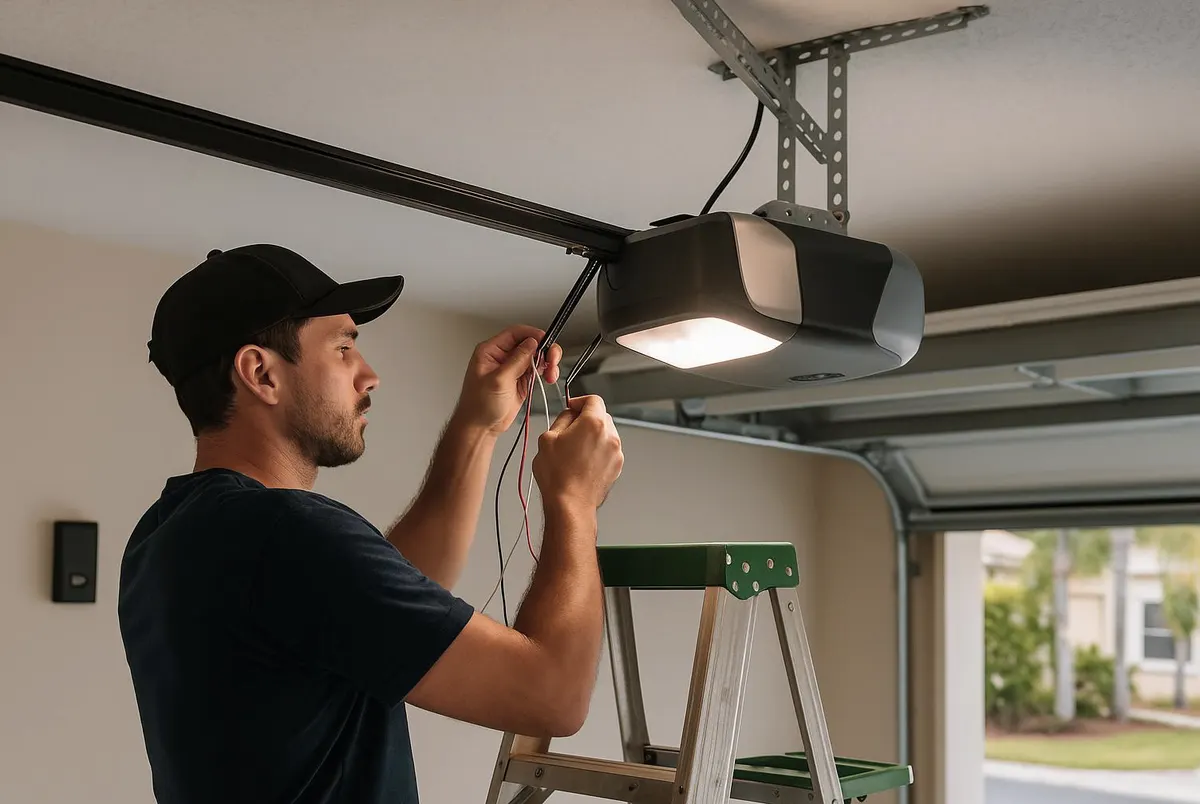
What a Technician Usually Finds First
On most service calls around Nocatee, the pattern looks the same: a door that was fine a few months ago is suddenly noisy, sluggish, or sitting crooked on its track. Nine times out of ten, the cause isn't one big failure — it's a handful of small things that built up quietly. Rollers packed with salt-air grit. Hinges that started to rust after a string of afternoon downpours. A bottom seal that swelled in the humidity and is now dragging on the slab. None of it is dramatic, but all of it is avoidable with a quick seasonal check.
You don't need a full inspection every month. One focused pass, done once a season, catches almost everything before it turns into a stuck door or a stranded car. Here's the routine, start to finish.
Tools You'll Need
- Work gloves
- A flashlight
- A can of garage-door-safe lubricant (silicone or lithium-based, not WD-40 as a long-term lube)
- A rag or shop towel
- A level (a smartphone level app works)
- A step stool
The 20-Minute Routine
- Look at the door while it moves. Stand off to the side, hit the opener, and watch the whole travel — up and down. It should move smoothly in one continuous motion. Jerking, pausing, or shaking at any point is a sign something in the track or hardware needs attention.
- Check the tracks for debris and alignment. Wipe down the inside of both tracks with a rag. Humid air pulls in dust and pollen that turns into a gritty film. While you're there, hold your level against each track — they should run straight and plumb, not bowed or leaning. A track that's pulled away from the wall even slightly is worth noting for later.
- Inspect rollers and hinges. With the door closed, shine the flashlight on each roller. Look for cracking, flat spots, or heavy rust — rollers near the coast corrode faster than inland ones. Check hinges for rust streaks or looseness where they bolt to the panel.
- Lubricate moving metal parts. Apply lubricant to the hinges, roller stems (not the wheels themselves if they're nylon), and the torsion spring coils if they're visible. A light coat is enough; wipe away excess so it doesn't attract more dust.
- Test the weatherstripping and bottom seal. Close the door and look along the bottom edge and sides for gaps, cracks, or sections that have swollen and started to curl. In this climate, rubber seals break down faster from heat and moisture than most homeowners expect.
- Check all hardware for looseness. Walk the frame with a wrench or socket set and snug up any visible bolts on the track brackets and hinges. Vibration from daily use loosens these gradually, and a loose bracket is often the first domino in a bigger track problem.
- Test the auto-reverse safety feature. Place a 2x4 flat on the ground where the door closes. The door should hit it and reverse immediately. Also test the photo-eye sensors by waving a hand through the beam while the door is closing — it should stop and reverse.
- Listen for new sounds. Run the door up and down once more with the garage quiet. Grinding, popping, or a metallic snap are not normal and are worth flagging even if the door still functions.
Where the Line Is: DIY vs. Technician
Everything above — visual checks, lubrication, tightening visible bolts, testing auto-reverse — is safe for a homeowner to do with basic tools. It takes about twenty minutes and it's the single best thing you can do to stretch the life of a system that's working against heat, salt air, and seasonal storms year-round.
What's not a DIY job: anything involving the torsion spring itself, cable tension, or realigning a track that's pulled away from the frame. Torsion springs are wound under extreme tension and are one of the leading causes of serious injury in home repair attempts. Cables under load behave the same way. If your check-up turns up a cracked roller, a sagging or bowed track, a spring that looks stretched or has a visible gap in its coils, or a door that's noticeably off-level, stop there and call it in rather than pushing further.
When to Call Precision Garage Door of Nocatee
If your seasonal check turns up anything beyond lubrication and minor tightening — a track out of alignment, rollers that are cracked or rusted through, a spring that looks worn, or a door that's just not moving the way it used to — that's the point to call us in. We offer Garage Door Maintenance & Tune-Up service that covers everything in this routine plus the parts of the job that need training and the right tools: spring tension checks, cable inspection, and precise track alignment. If something's already failed — a snapped cable, a door that's jumped the track, a spring that's let go — our Cable & Roller Replacement and Off Track Door Repair services get it back in working order the same visit in most cases.
A twenty-minute check twice a year catches most problems while they're still cheap and simple to fix. If yours turns up something bigger, call Precision Garage Door of Nocatee — we serve Nocatee, Ponte Vedra Beach, Ponte Vedra, St. Augustine, Jacksonville Beach, St. Johns, Fruit Cove, and Palm Valley, and we'll get your door diagnosed and fixed right the first time.